Xander Vogel · 13 September 2026
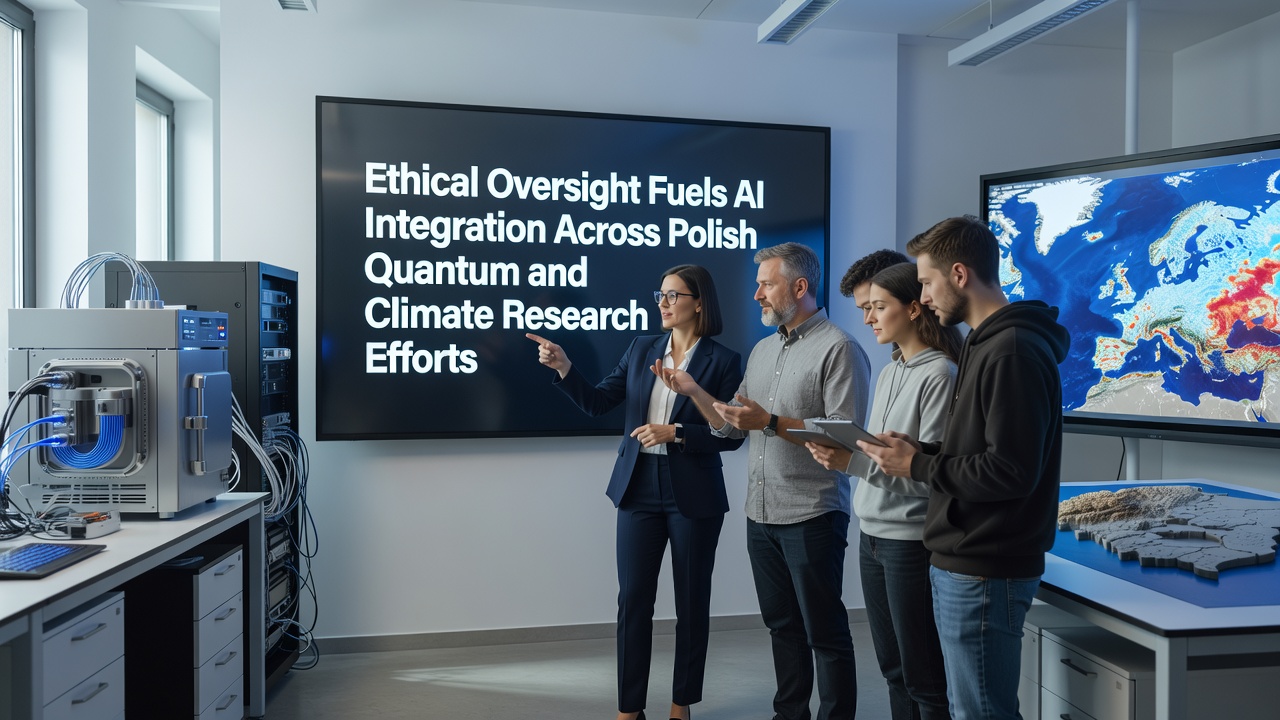
Ethical Oversight Fuels AI Integration Across Polish Quantum and Climate Research Efforts
Poland has expanded its research programs in quantum computing and climate modeling since the early 2020s, and ethical oversight committees now coordinate with these projects to guide AI tool deployment. Government agencies and academic institutions established review boards that examine data handling practices, algorithmic transparency, and potential societal impacts before new AI systems receive approval for use in sensitive simulations. These boards operate under national regulations that align with broader European Union frameworks, which require documentation of decision-making processes in AI models applied to environmental forecasting and quantum state analysis.
Regulatory Foundations Supporting Integration
Polish legislation passed in 2024 created mandatory ethics assessments for any AI component entering public research facilities, and this requirement covers quantum hardware calibration routines as well as climate data processing pipelines. Researchers submit detailed reports on training datasets, bias mitigation steps, and error propagation controls; review panels then issue clearance or request modifications. Data shows that projects passing these assessments achieve faster integration timelines because compliance reduces later rework. The European Commission's approach to artificial intelligence provides reference standards that Polish bodies adapt to local contexts, particularly around high-risk applications in scientific modeling.
AI Applications in Quantum Research
Quantum laboratories across Poland employ machine learning algorithms to optimize qubit control and error correction codes, while ethics panels verify that these algorithms do not inadvertently expose proprietary hardware configurations. One Warsaw institute integrated reinforcement learning agents into its quantum simulation environment in late 2025, and the associated oversight process documented every parameter adjustment to maintain audit trails. Similar protocols now extend to multi-institution collaborations that share quantum network testbeds, ensuring consistent standards for access logging and result verification.
Climate research teams apply neural networks to downscale global circulation model outputs for regional impact studies, and ethical review requires explicit justification for each input variable selected from satellite archives. Observers note that September 2026 will mark the launch of a national platform linking quantum-enhanced optimization routines with climate adaptation scenario planning, an effort coordinated through the Polish Ministry of Science and Higher Education. Project leads must demonstrate that AI-generated recommendations undergo human review before informing policy documents.
Cross-Disciplinary Coordination Mechanisms
Joint working groups formed in 2025 bring together quantum physicists, climate scientists, ethicists, and legal experts to map potential overlap between research domains. These groups developed shared templates for impact assessments that address both computational resource allocation and long-term environmental consequences of AI training runs. Institutions report that standardized templates have reduced approval times by approximately thirty percent compared with earlier ad-hoc reviews. Training programs now include modules on responsible AI use, covering topics such as reproducibility requirements and stakeholder consultation procedures.
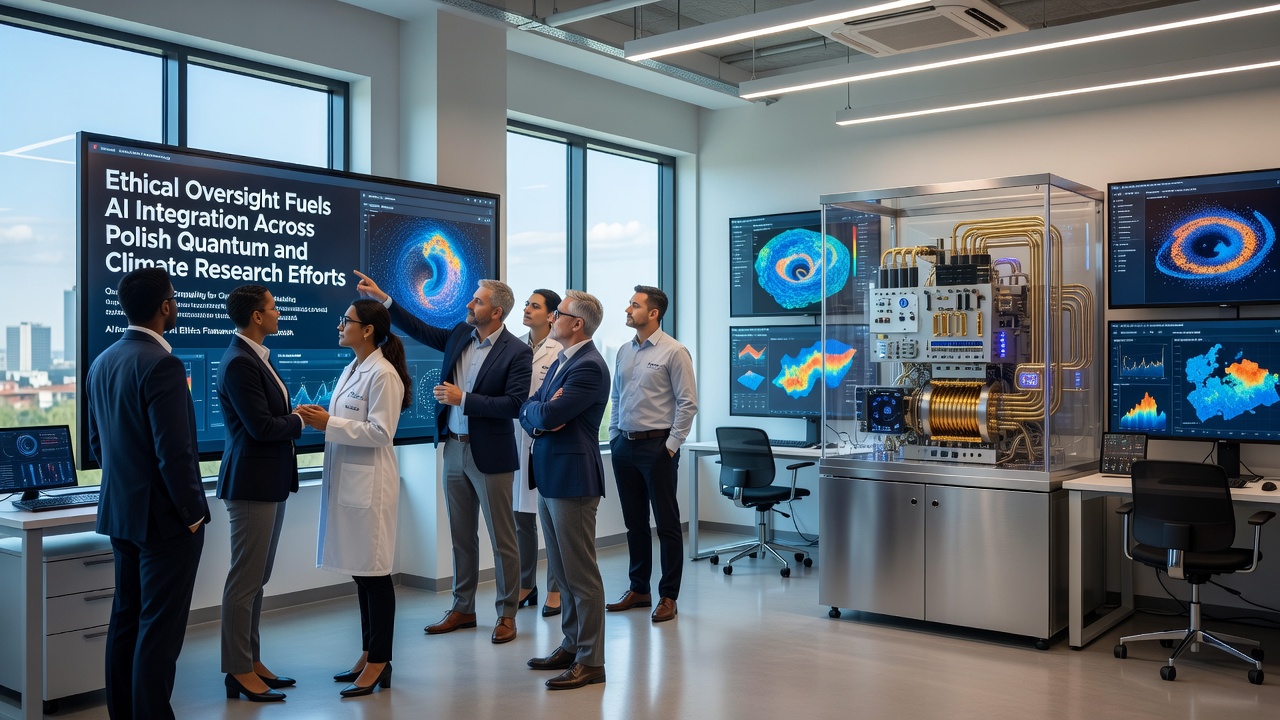
International partnerships supply additional benchmarks; for instance, Canadian research councils have shared frameworks for AI accountability that Polish teams have referenced when designing consent mechanisms for data contributors. Australian climate science centers have contributed case studies on transparent model documentation, which Polish programs incorporate into their own reporting formats. These exchanges occur through formal memoranda that specify mutual recognition of ethics certifications, thereby avoiding redundant reviews for collaborative experiments.
Implementation Outcomes and Monitoring
Monitoring dashboards track compliance metrics across funded projects, revealing steady increases in the proportion of AI components that complete ethics review without revision requests. Figures from the first half of 2026 indicate that over eighty percent of submissions now meet criteria on first evaluation, reflecting accumulated institutional experience. Audit reports highlight successful examples where ethical oversight identified unintended correlations in training data that could have skewed climate projection outputs, prompting dataset adjustments before deployment.
Quantum research groups have documented parallel benefits, including clearer attribution of algorithmic contributions when multiple teams contribute to hybrid classical-quantum workflows. Oversight bodies continue to refine evaluation criteria as new AI techniques emerge, with particular attention to generative models that produce synthetic datasets for training downstream systems. Regular workshops disseminate updated guidance and allow researchers to present challenges encountered during implementation.
Conclusion
Ethical oversight structures in Poland continue to evolve alongside advances in AI, quantum computing, and climate science, creating feedback loops that strengthen both research integrity and technological adoption. National policies, European standards, and international exchanges together shape procedures that researchers follow when embedding AI into experimental and modeling pipelines. Continued monitoring through 2026 and beyond will determine how these frameworks adapt to emerging capabilities while maintaining consistent accountability across disciplines.