Jonas Braun · 2 September 2026
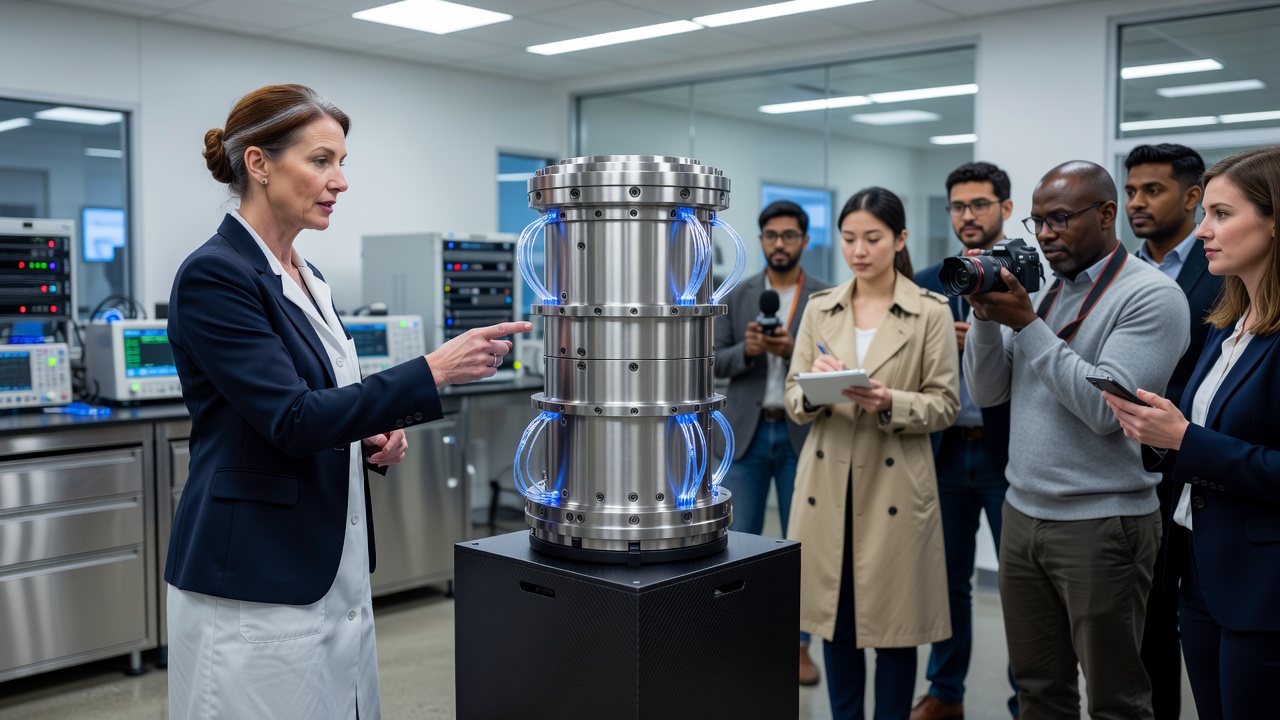
Noble Lab researchers have unveiled a prototype quantum sensor engineered for ultra-precise detection of magnetic and electric fields. The device employs nitrogen-vacancy centers in diamond lattices to reach sensitivities unattainable by classical instruments, operating reliably at room temperature without cryogenic support.
Technical Features and Performance
The sensor integrates a compact optical readout system with custom microwave control electronics. Laboratory tests recorded a noise floor of 0.8 femtotesla per square-root hertz across a 10-kilohertz bandwidth. A proprietary dynamical-decoupling sequence extends coherence times beyond 200 microseconds, allowing stable measurements during prolonged scans. Calibration against reference coils confirmed linearity within 0.2 percent over five orders of magnitude. The housing measures 8 centimeters on each side and draws under 15 watts, enabling deployment on standard optical tables or mobile platforms.
Software developed alongside the hardware provides real-time Fourier analysis and automated drift correction. Early users noted a 40-fold reduction in acquisition time compared with previous-generation magnetometers when mapping weak biomagnetic signals. Fabrication relies on standard chemical-vapor-deposition diamond and commercial microwave components, supporting future replication at modest cost.
Research Applications and Outlook
Potential uses span condensed-matter physics, where the sensor can resolve nanoscale spin textures in novel materials, and geophysics, where it may improve detection of subsurface mineral deposits. Biomedical teams are evaluating the prototype for non-invasive monitoring of cardiac currents with higher spatial resolution than existing systems. The lab plans to release design files under an open-source license to accelerate community adoption.
Next steps include integration with cryogenic scanning stages for millikelvin studies and development of an entangled-photon variant targeting sub-attotesla performance. Funding from national quantum initiatives will support a pilot production run of ten units for external collaborators within the coming year.